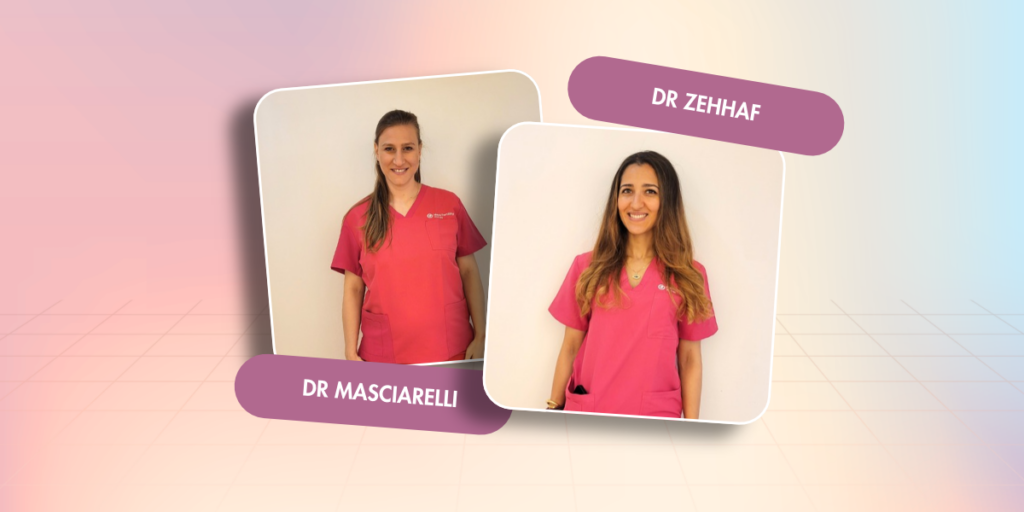
Undergoing a Medically Assisted Reproduction (MAR) journey inevitably raises a number of doubts, questions and concerns. Among the most important, but also most widely discussed, aspects is ovarian stimulation. We spoke about this with Chaimae Zehhaf, midwife and Head of the Medical Assistance and Operating Theatre Team, and Veronica Masciarelli, nurse and medical assistant at our Next Fertility ProCrea clinic.
Hormonal stimulation, explains Veronica Masciarelli, is “a medical and pharmacological procedure involving the administration of hormones to stimulate the ovaries to produce a greater number of eggs by promoting the simultaneous maturation of several follicles”. During a natural menstrual cycle, only one dominant follicle reaches full maturity and releases an egg. Ovarian stimulation, on the other hand, aims to obtain several mature follicles to increase the chances of conception.
What Is Hormonal Treatment in Medically Assisted Reproduction?
Hormonal treatment in medically assisted reproduction is a pharmacological treatment that stimulates the ovaries to produce multiple eggs during the same menstrual cycle. It is used in medically assisted reproduction treatments to increase the chances of retrieving mature eggs and improve the likelihood of treatment success.
| Aspect | Hormonal treatment in assisted reproduction |
|---|---|
| Purpose | To stimulate the maturation of multiple follicles and obtain a greater number of eggs. |
| When is it recommended? | During assisted reproduction treatments, in cases of ovulatory disorders and as part of fertility preservation, such as elective egg freezing. |
| Duration | Usually 10 to 15 days, depending on the personalised treatment protocol. |
| Administration | Daily subcutaneous injections using easy-to-use prefilled pens. |
| Medical monitoring | Regular transvaginal ultrasound scans and blood tests to assess follicular growth and the response to treatment. |
| Most common side effects | Abdominal bloating, breast tenderness, nausea, headaches and hot flushes, generally mild and temporary. |
| Risks | Ovarian hyperstimulation syndrome is a rare complication, with prevention based on ongoing medical monitoring. |
When Is Hormonal Stimulation Recommended?
Chaimae Zehhaf explains that stimulation can be used in different circumstances: “Ovulatory disorders, assisted reproduction treatments involving both first- and second-level procedures, egg cryopreservation or social freezing. It is recommended whenever the aim is to maximise egg retrieval or follicular maturation”.
The choice of hormonal stimulation protocol is personalised. “It is determined by a specialist in medically assisted reproduction and is based on several important medical factors, including a thorough medical history and an assessment of the patient’s health, chronological age, but also biological age and ovarian reserve. To assess ovarian reserve, continues Chaimae Zehhaf, certain parameters can be measured non-invasively: the antral follicle count, assessed through a simple transvaginal ultrasound scan, and a blood test to analyse four key hormones, including AMH (anti-Müllerian hormone)”.
How Does the Treatment Work?
Protocols vary depending on the type of treatment planned. “The duration, dosage and type of medication differ depending on whether it is a first-level or second-level treatment”, explains Veronica Masciarelli. Administration has also become much easier thanks to advances in pharmacology: today, medications are injected using pens similar to those used for insulin. “We always divide our patients into two categories,” jokes Chaimae Zehhaf, “the brave ones who administer the medication themselves and the even braver ones who entrust themselves to their partner’s inexperienced hands. But in both cases, the results are positive!”
Generally, stimulation lasts between 10 and 15 days, with daily subcutaneous injections. The cycle ends when the follicles have reached the appropriate level of maturity, “which for us,” she explains, “means a size of between 16 and 20 mm and a specific hormonal balance”.
Side Effects and Risks: What You Need to Know
One of the main concerns among patients relates to possible side effects. “These symptoms are temporary and generally well tolerated,” reassures Veronica Masciarelli, “such as hot flushes, headaches, nausea or breast tenderness, similar to those associated with premenstrual syndrome”. These symptoms usually disappear on their own within a short period and can be managed by adjusting the medication dosage according to the patient’s response.
A more serious, although rare, side effect is ovarian hyperstimulation syndrome (OHSS). “It can cause an excessive accumulation of fluid in the abdomen, which occurs about a week after egg retrieval,” explains Veronica Masciarelli. “This fluid needs to be drained if it is associated with significant symptoms, such as excessive abdominal swelling, abdominal pain or tension. It is a very dangerous complication, but one that we completely eliminate through regular monitoring”. During stimulation, blood tests and ultrasound scans are performed every other day to monitor follicular growth and hormonal response. “If the response is excessive,” she adds, “the treatment is promptly adjusted or, if necessary, discontinued”.
Ongoing Communication with Patients
“In addition to monitoring, communication with our patients is also essential,” emphasises Chaimae Zehhaf. “Patient feedback is important to understand what they are experiencing and how they feel. This is why our patients remain in constant contact with us, both during and outside working hours”.
Common Myths and Frequently Asked Questions
One of the most widespread concerns among patients is the possible link between hormonal stimulation and cancer. On this point, Chaimae Zehhaf is very clear: “There is no scientific evidence linking ovarian stimulation to an increased risk of cancer. Cancer and oncological diseases result from long-term exposure to risk factors. Ovarian stimulation, however, is a short-term medical treatment: acute exposure to hormones is not sufficient to trigger oncogenesis and therefore the development of a new oncological disease”. She also adds that, for this reason, “patients with cancer can also undergo ovarian stimulation, subject to agreement with their oncologist”.
And what about sexual intercourse during stimulation? “There are no contraindications,” replies Veronica Masciarelli. “The only side effect is that the injections cause the ovaries to enlarge, which may result in some discomfort. However, sexual intercourse does not compromise the success of the treatment”.
Advice from Our Experts
“My advice is not to experience this period as a time of restrictions,” says Chaimae Zehhaf. “It is certainly beneficial to socialise, spend free time doing things you enjoy and maintain your usual activities, because the physical and emotional commitment required is considerable”.
Healthy habits to adopt include moderate physical activity, adequate rest (at least 7–8 hours per night) and proper hydration. In addition, at least a few weeks before starting treatment, it is advisable to limit alcohol, smoking, drugs, narcotic substances and caffeine. “It is also useful to reduce dairy consumption,” she adds, “because dairy products can create an inflammatory state that is unfavourable both to stimulation and to the development of a pregnancy”.
A Journey Built on Trust and Continuous Support
Ovarian stimulation is a key part of medically assisted reproduction, but it is essential to fully understand every aspect before beginning treatment. With the support of a medical team with many years of experience and continuous monitoring, patients can approach stimulation with greater peace of mind. Advances in medication, personalised protocols and open communication between patients and healthcare professionals are the tools that make treatment increasingly safe and effective.
FAQ – Frequently Asked Questions
What Is Hormonal Treatment in Medically Assisted Reproduction?
Hormonal treatment in medically assisted reproduction is a pharmacological treatment that stimulates the ovaries to promote the simultaneous maturation of several follicles. The aim is to obtain a greater number of mature eggs for use in medically assisted reproduction treatments.
How Long Does Hormonal Treatment Last?
The duration of hormonal treatment varies depending on the chosen treatment protocol, but it generally lasts between 10 and 15 days. During this period, ultrasound scans and blood tests are carried out to assess the body’s response.
Do Fertility Medications Have Side Effects?
Yes, medications used in medically assisted reproduction can cause side effects that are generally mild and temporary, such as abdominal bloating, breast tenderness, nausea, headaches and hot flushes. More rarely, ovarian hyperstimulation syndrome may occur, a complication that can be prevented through careful medical monitoring.
Does Hormonal Treatment Increase the Risk of Cancer?
No. The scientific evidence currently available does not demonstrate an increased risk of cancer associated with ovarian stimulation used in medically assisted reproduction treatments. It is a short-term treatment carried out under close medical supervision.
Can You Have Sexual Intercourse During Hormonal Treatment?
Yes. In general, there are no contraindications to sexual intercourse during ovarian stimulation. However, the enlargement of the ovaries may cause mild discomfort or a feeling of abdominal tension in some patients.
Medically reviewed by Chaimae Zehhaf – Midwife, Head of the Medical Assistance and Operating Theatre Team. Updated on 20/11/2026.